Precious History of
Castel-
Mozzo
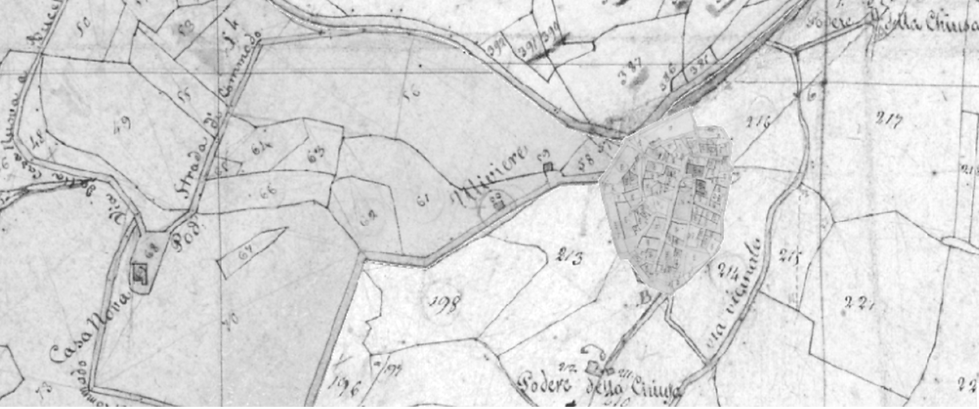
Nestled in a picturesque landscape, this charming medieval village, almost untouched by time, traces its origins to the Etruscan-Roman era.
First mentioned in the 9th-century records of the Amiata Abbey of San Salvatore as Casale Mustia, it later appears in the 1213 documents of the State Archive of Siena as Castel Mozzo.
The locals affectionately call it Castello.
Like the entire region, it once belonged to the powerful Cacciaconti della Scialenga lords, whose vast estates included the Fratta farm, near Sinalunga, extending to the Castrum of Montepulciano.
In 1270, Castel Mozzo became part of the Republic of Siena, and in 1354, it was entrusted to the Hospital of Santa Maria della Scala in Siena. The emblem of this hospital, a ladder, can still be seen adorning the facades of some of the surrounding farmhouses.
After a period under the Salimbeni, it was acquired by the Piccolomini, who remained its owners until Siena's reconquest.
Following the defeat of the Republic of Siena, Castelmuzio was annexed by the Medici into the Grand Duchy of Tuscany.
Perched on the crest of a tuff hill, under the watchful gaze of Monte Lecceto, the village overlooks the verdant Trove valley.
It retains the quintessential medieval structure of a fortified castle, encircled by sturdy walls and bastions.
At the village entrance, before the short ascent to the main gate, lies the stone on which San Bernardino of Siena once rested, now part of a memorial to the fallen.
The ancient gate still has its original "gangari" for opening and closing, and the "piombatoi" from which large stones were thrown to fend off invaders.
In the heart of the village, the central square is home to its most fascinating buildings. The tower, now the recently restored Palazzo Fratini, once served as the seat of local jurisdiction. The Hospital of San Giovanni Battista provided shelter and nourishment to travelers and orphans, and even arranged dowries for impoverished girls. The Confraternity of the Holy Trinity and San Bernardino, founded in 1450 and dedicated to the saint who preached here, housed a pharmacy and a hospice with four beds for pilgrims traveling the nearby Via Francigena.
Today, the church hosts a Museum of Sacred Art, rich with treasures: a Madonna with Saints attributed to Pietro Francesco degli Orioli, a Madonna and Child from the school of Duccio di Boninsegna, paintings from the schools of Beccafumi, Domenico Manetti, and Sano di Pietro; a rare Etruscan terracotta funerary urn from Abbadia Sicille, and a fascinating collection of sacred artifacts.
A particularly precious piece is a small panel by Sano di Pietro, featuring the monogram of Christ encircled by a golden sun on a blue background, gifted by San Bernardino to the village, now enshrined in an 18th-century gold and enamel tabernacle.A short distance from Castelmuzio lies the Pieve of Santo Stefano in Cennano, along the road to Montisi. This early Christian church, built on the ruins of an ancient Roman temple, adds to the timeless allure of the region.